
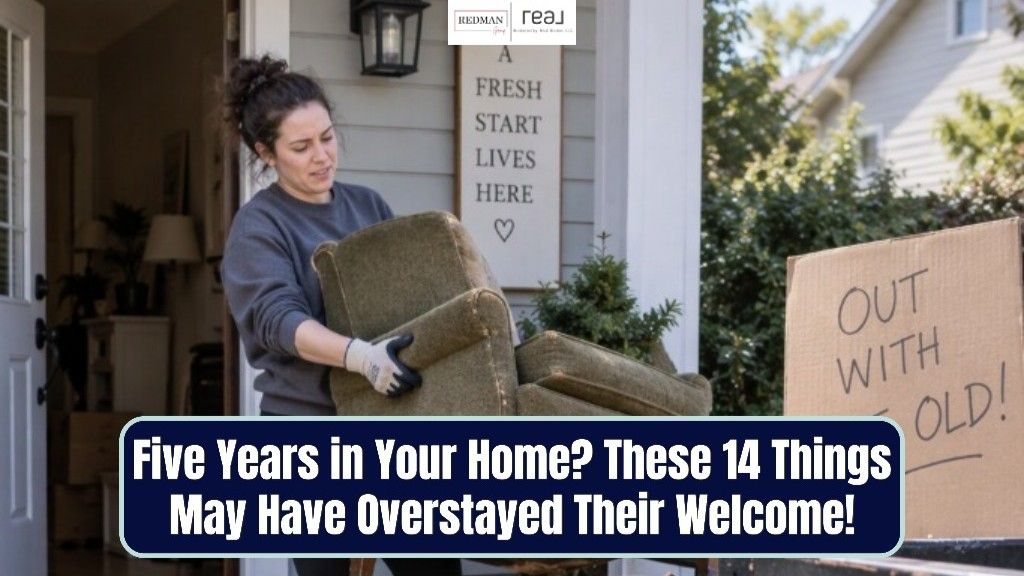
Five Years in Your Home? These 14 Things May Have Overstayed Their Welcome!
Remember when you first moved into your home?
The closets seemed enormous.
The kitchen cabinets had plenty of space.
And you probably wondered how you would ever fill that big garage.
Fast-forward five years.
The closets are bursting, the kitchen drawers barely close, and the garage has somehow become a storage facility for things you haven't looked at since moving day.
Sound familiar?
The funny thing about clutter is that it rarely arrives all at once. It sneaks in one shopping bag, one Amazon delivery and one "I might need that someday" at a time!
Professional home organizers say that five years is a particularly good time to take stock of what you've accumulated.
Your lifestyle may have changed, your family may have grown, and your interests may be completely different from when you first moved in.
But your belongings haven't necessarily kept up.
The good news?
You don't need to spend an entire weekend emptying every cupboard in the house.
Start small, work through one area at a time, and consider saying goodbye to these 14 things that may have outlived their usefulness.
1. The Collection of Reusable Shopping Bags
Somewhere in your home, there's probably a bag full of other bags.
And possibly another bag containing even more bags!
Between shopping trips, conferences, promotional giveaways and community events, reusable bags have a habit of multiplying.
Keep a reasonable number that you genuinely use.
Choose your favorites and donate the rest if they're in good condition.
The same goes for those promotional water bottles, travel mugs and branded giveaways collecting dust in the cabinets.
You really don't need 27 water bottles for a household of two!
2. Mystery Cables and Instruction Manuals
Every home seems to have a drawer filled with unidentified cables.
Phone chargers from three phones ago.
Computer cords that might belong to something.
And instruction manuals for appliances you no longer own.
If you can't identify what a cable belongs to, and you've checked that it isn't needed for any current equipment, consider recycling it.
Many electronics retailers and recycling programs accept certain electronic accessories.
As for instruction manuals, many manufacturers now provide digital copies online.
Just make sure you retain any important warranty information or documentation before disposing of the paper versions.
3. Towels and Bedding That Have Seen Better Days
Open your linen closet.
How many sets of sheets do you actually use?
And how many towels are hiding at the back because they're faded, scratchy or have mysteriously developed holes?
Keep enough good-quality linens for your household and occasional guests.
Consider donating clean, usable extras to an organization that accepts them.
Some animal shelters may also appreciate suitable old towels.
And suddenly, your linen closet might actually close properly!
4. Exercise Equipment That Has Become Furniture
Remember that exercise bike you were absolutely going to use every morning?
Or the collection of weights that hasn't moved in years?
Perhaps the treadmill has become the world's most expensive clothes rack.
There's no shame in changing your interests or fitness routine.
But if equipment hasn't been used for years, consider whether it still deserves valuable space in your home.
Selling or donating unused equipment can free up an entire corner of a bedroom, garage or bonus room.
And who knows?
You might discover enough space for an activity you actually enjoy.
5. The Projects You'll Get Around to "Someday"
Ah, someday.
That magical day when we'll finally refinish the old dresser, learn to make homemade bread, complete the craft project or repair the broken chair.
Unfortunately, someday can turn into five years surprisingly quickly.
Take a look at those unfinished projects.
Are you genuinely excited about completing them?
Do you realistically have the time?
If the answer is no, consider letting them go.
Someone else might be delighted to take on the project.
And you'll no longer have to feel slightly guilty every time you walk past it!
6. Decorations You Don't Even Notice Anymore
Over time, shelves and tables tend to collect decorative accessories.
Candles.
Picture frames.
Vases.
Ornaments.
Souvenirs.
And those mysterious little objects that seemed like a good idea when you purchased them.
There's nothing wrong with displaying things you love.
But too many accessories can make a room feel cluttered.
Try removing a few items and see how the space looks.
Sometimes one beautiful vase or meaningful photograph makes a stronger impression than an entire shelf filled with decorations.
A little breathing room can make your home feel more spacious without moving a single wall.
7. Furniture and Decor That Never Found a Home
Perhaps you brought a rug from your previous property that doesn't quite fit anywhere.
Or a piece of artwork that's been leaning against the garage wall since moving day.
Maybe there's an occasional chair that has spent five years being moved from room to room.
If something doesn't work with your current home or lifestyle, it may be time to part with it.
Sell it.
Donate it.
Or pass it along to someone who can enjoy it.
There's no rule saying you must keep furniture simply because you've owned it for years.
8. Leftover Paint, Tiles and Building Materials
This is a particularly common one in Florida homes.
The garage shelves are filled with half-empty paint cans.
Boxes of leftover floor tiles.
Old grout.
And building materials from a renovation completed several years ago.
It's sensible to keep a small quantity of useful materials for future repairs.
A few matching tiles can be valuable if one becomes damaged.
And a clearly labeled sample of wall paint can make touch-ups easier.
But dried-out paint and materials you no longer need are simply taking up space.
Check your local disposal requirements before getting rid of paint, solvents or other potentially hazardous materials.
In Lake, Orange, Osceola and Polk counties, disposal programs and accepted materials can vary.
Never pour unwanted paint or chemicals into drains or stormwater systems.
9. Kitchen Gadgets That Promised to Change Your Life
Kitchen cabinets are prime territory for impulse purchases.
The specialty vegetable slicer.
The elaborate sandwich maker.
The oversized appliance you used twice.
And the kitchen gadget that seemed absolutely essential after watching a cooking demonstration.
If you use it regularly, wonderful!
But if it hasn't been touched in several years, ask yourself whether you really need to keep it.
The same applies to duplicate utensils, chipped dishes and containers without matching lids.
Clearing out unused kitchen equipment can make everyday cooking much more enjoyable.
And you might finally have room to store the things you actually use.
10. Wellness Gadgets From Abandoned Routines
We've all been there.
A new wellness trend appears.
We become enthusiastic.
We purchase the equipment.
And for a few weeks, we're completely committed.
Then life gets busy.
Five years later, the gadget is still sitting in a bathroom cabinet.
Whether it's a juicer, massage device or another wellness accessory, consider whether it's still part of your routine.
If not, selling or donating suitable equipment can free up valuable storage space.
You don't have to keep something forever simply because it was expensive when you purchased it.
11. Furniture That No Longer Fits Your Lifestyle
Our homes change as our lives change.
Perhaps the formal dining room is rarely used.
The oversized coffee table makes the living room difficult to navigate.
Or the spare chair has become a permanent dumping ground for clothes.
Take a fresh look at how your rooms function.
Does every piece of furniture serve a purpose?
Does the arrangement make it easy to move around?
Could removing one unnecessary piece make the room feel larger and more comfortable?
Sometimes the best decorating decision isn't buying something new.
It's removing something you no longer need.
12. Expired Bathroom and Cleaning Products
Bathroom cabinets can become surprisingly crowded.
Old sunscreen.
Expired cosmetics.
Half-used shampoo bottles.
Dried-out nail polish.
And cleaning products purchased for a job you completed years ago.
Check expiration dates where applicable, and discard products that are no longer safe or suitable to use.
Be particularly careful with old medications and household chemicals.
Follow local disposal guidance rather than putting hazardous products down the drain.
Once you've cleared the cabinets, give the shelves a good cleaning and organize what remains.
It's a small project that can make your daily routine feel much easier.
13. Boxes You Still Haven't Unpacked
This one might be the biggest giveaway that it's time to declutter.
If you've lived in your home for five years and still have unopened moving boxes, it's worth asking what's inside them.
You may discover sentimental belongings worth keeping.
Important documents.
Or things you'd completely forgotten you owned.
But you may also find items that no longer have a place in your life.
Open the boxes and make a decision.
Keep.
Donate.
Sell.
Recycle.
Or dispose of responsibly.
The goal isn't necessarily to get rid of everything.
It's to stop storing belongings indefinitely simply because you haven't made time to unpack them.
14. The Garage Collection of "Just in Case" Items
And finally, let's talk about the garage.
In Central Florida, garages often become the unofficial storage headquarters of the household.
Old garden equipment.
Broken pool toys.
Unused patio furniture.
Empty boxes.
Holiday decorations.
And mysterious items that nobody seems to remember purchasing.
Before long, there's barely enough room to park the car!
Set aside a few hours to sort through the contents.
Keep equipment you genuinely use.
Organize seasonal items into labeled containers.
Dispose of broken or unusable belongings appropriately.
And consider installing shelving to make better use of vertical space.
Just make sure stored items don't obstruct exits, electrical panels or important equipment.
A tidy garage can be one of the most satisfying improvements you make to your home.
Especially when you can finally park the car inside again!
Why Decluttering Makes Your Home Feel Bigger
Here's something interesting.
You don't necessarily need more square footage to make your home feel more spacious.
Sometimes you simply need less stuff.
When surfaces are clear, furniture is arranged properly and storage areas aren't overflowing, rooms often feel larger and more comfortable.
It's also easier to clean and maintain a home when everything has a designated place.
And the benefits aren't just visual.
Less clutter can make everyday routines simpler.
You spend less time searching for things.
You can find what you need.
And you may discover that your existing home works better for your lifestyle than you realized.
Thinking About Selling? Decluttering Is One of the Best Places to Start
If you're considering putting your home on the market, decluttering becomes even more important.
Buyers want to see the space, not everything you've accumulated over the years.
Overfilled closets can make storage appear limited.
Crowded furniture arrangements can make rooms feel smaller.
And cluttered countertops can distract from otherwise attractive kitchens and bathrooms.
Removing unnecessary belongings helps buyers focus on the property's features.
It also makes professional photography more effective and can make preparing for showings much easier.
And there's another advantage.
Everything you declutter before listing is one less thing you'll have to pack when you move!
Whether you're selling a home in Clermont, Davenport, Kissimmee, Orlando or elsewhere in Central Florida, thoughtful preparation can make a meaningful difference to how buyers experience the property.
The Bottom Line: Your Home Doesn't Need More Storage. It May Just Need Less Stuff!
Five years can pass surprisingly quickly.
And during that time, our homes naturally accumulate belongings that once seemed useful, important or absolutely essential.
But not everything needs to stay forever.
Start with one drawer.
Then one cabinet.
Then perhaps a closet.
You don't need to declutter the entire house in a weekend.
Just make steady progress and be realistic about what you genuinely use and enjoy.
And remember, getting rid of something you no longer need doesn't mean you've wasted money or made a mistake.
It simply means your needs have changed.
Because sometimes the best home improvement you can make doesn't involve buying anything at all. It involves making room to enjoy what you already have!
.
Categories
Recent Posts